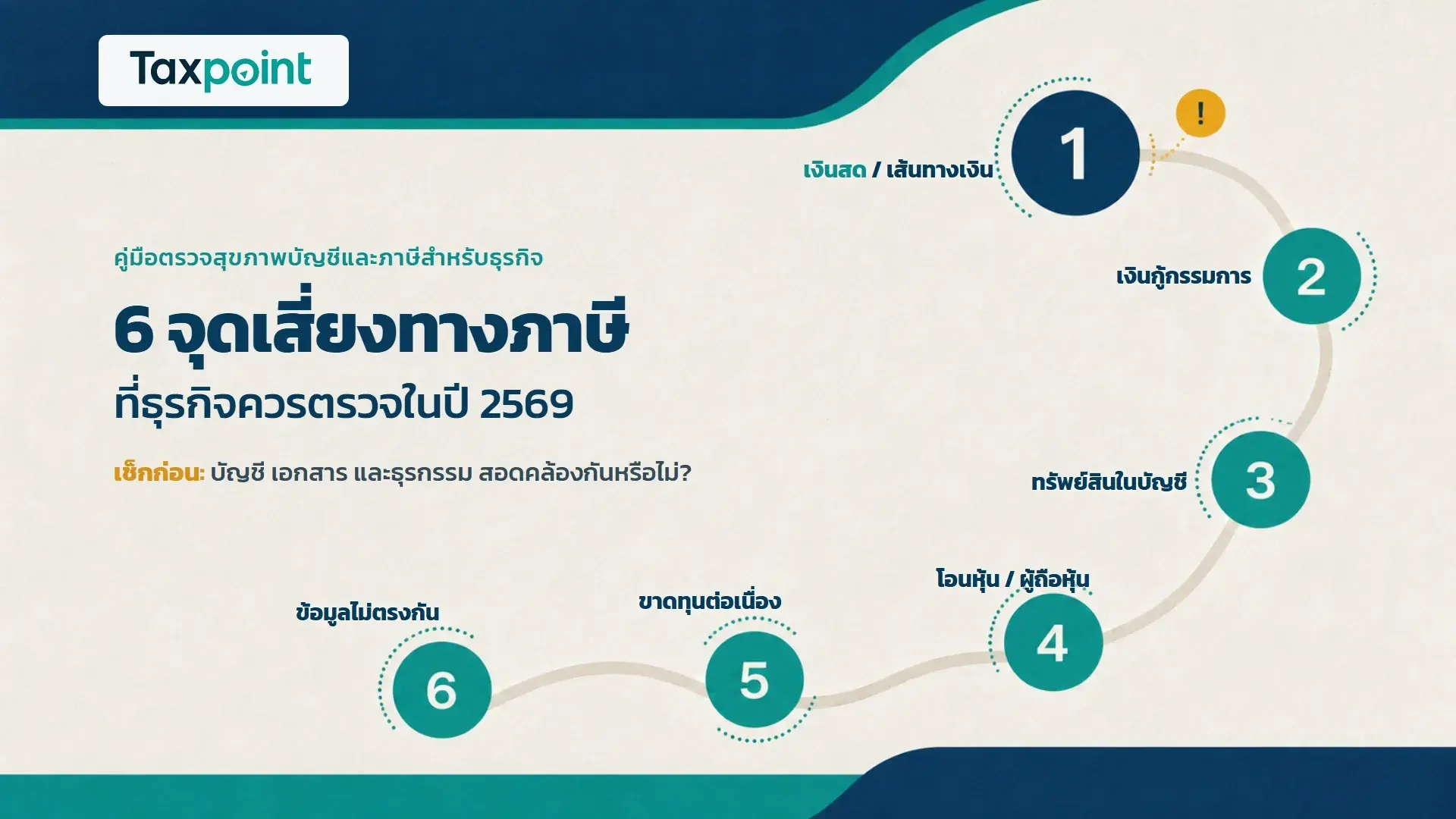
Review six areas where accounting, tax, banking, asset, and shareholder records may diverge, with a practical evidence checklist for 2026.
14 views
Six Tax-Risk Signals Thai Businesses Should Review in 2026
Why Risk Analytics Matters to a Business
The Revenue Department’s annual report describes the use of Data Analytics on internal and external data to analyze risk and group businesses. A separate SGATAR update refers to its presentation on “Artificial Intelligence (AI) in Tax Administration.” The useful business response is not to guess what an algorithm might see, but to ensure that the same transaction tells a consistent story across every record.
Sales ledgers, bank statements, tax invoices, VAT returns, withholding-tax filings, platform reports, inventory, assets, loans, and corporate records should reconcile. When figures or explanations differ, the business should identify the cause and retain evidence instead of waiting for a question from an authority.
Six Areas to Review
1. The Business Mainly Uses Cash but Lacks a Complete Audit Trail
Using cash is not itself an offence, and the reviewed sources do not state that a business must show a bank account in its financial statements. The risk is practical: cash without a continuous record makes it difficult to support sales, expenses, and the closing cash balance, especially when POS totals, receipts, daily sales reports, VAT returns, and purchases do not align.
Maintain a daily cashbook or receipt-and-payment report, perform end-of-day cash counts, keep source documents, and separate personal cash from business cash. When cash is later deposited, the deposit should be traceable to the relevant sales dates and sources.
2. Large Loans to Directors or Related Parties Have Unclear Terms
A large loan receivable from a director does not automatically prove that retained earnings were distributed as a disguised dividend. Retained earnings do not turn a loan into a dividend by themselves. Review the agreement, approval, actual payment, repayment schedule, collections, interest terms, and business rationale.
Under section 65 bis (4), when a company lends money without compensation or below market value without reasonable cause, an assessment officer may assess market-rate interest. A court summary published by the Revenue Department also illustrates that the source of funds, borrowing cost, and transaction facts matter; the balance alone is not decisive.
If the transaction is in substance a dividend, the company should follow the applicable corporate and tax process. It should not be recorded as a loan merely to make the accounting form differ from the facts.
3. Assets Used or Purchased by the Business Do Not Match the Ownership Records
Vehicles, land, buildings, machinery, and other significant equipment should be traceable from quotations and contracts through payment, title, the fixed-asset register, depreciation, and related expenses. Thailand’s Accounting Act requires accounts to present the entity’s actual performance and financial position, supported by complete and correct accounting documents.
If a director owns an asset that the company uses, document the right of use, rent, expenses, and allocation of obligations appropriately. If the company owns the asset but it is absent from the records, investigate whether it was misclassified, omitted, or tied to another unrecorded transaction.
4. A Shareholding Change or Share Transfer Lacks Complete Documents and Tax Analysis
A “more than 50% change” should not be used as a universal tax-risk rule. Review why ownership changed, the number of shares, the price or value, transfer documentation, shareholder register, payment evidence, and relevant approvals.
For a share-transfer instrument, Thailand’s stamp-duty schedule imposes THB 1 for every THB 1,000 or fraction thereof, calculated on the paid-up value or the value stated in the instrument, whichever is higher, and identifies the transferor as the person liable for the duty. Income-tax treatment depends on the facts: a sale may produce a gain for the transferor, while a gift can have consequences for the recipient in some cases. A recipient does not automatically earn taxable income whenever ownership changes.
5. Continuing Losses Do Not Match the Business’s Cash, Assets, or Activity
The reviewed official sources do not establish “more than three years of losses” as an automatic audit trigger. A business can incur losses during startup, investment, intense competition, high-cost periods, exceptional events, or an industry downturn. The figures still need a coherent explanation.
Review why sales may rise while losses deepen, how assets or investments grow despite continuing losses, who provides liquidity, how director funding is recorded, and whether costs and inventory match actual operations. The explanation should be supported by records rather than a verbal narrative alone.
6. Accounting Records Differ from Bank, Platform, or Counterparty Data
Section 3 septendecies of the Revenue Code requires financial institutions, state financial institutions, and electronic-money service providers to report persons with specified transactions: at least 3,000 deposits or incoming transfers across all accounts in a year, or at least 400 such transactions with an aggregate value of at least THB 2 million. Meeting a reporting threshold does not mean every receipt is revenue or that the account holder has committed an offence. It does make the separation of sales, loans, capital, inter-account transfers, and personal items more important.
Qualifying electronic platforms must also prepare and submit a special account showing receipts collected from merchants. The Revenue Department’s information page describes covered platforms as those incorporated in Thailand with annual business revenue exceeding THB 1 billion; the requirement applies to accounting periods beginning on or after 1 January 2024.
Businesses should therefore reconcile channel-level sales to bank receipts, platform statements, tax invoices, and filed returns, while documenting receipts that are not sales.
Pre-Closing Accounting and Tax Health Checklist
Reconcile every bank account to the general ledger and investigate outstanding items monthly.
Connect cash totals to receipts, sales reports, POS data, and bank deposits.
Separate personal funds, capital, loans, and business revenue.
Review director and related-party loans, including agreements, interest, approvals, and repayment.
Match the fixed-asset register to purchase evidence, payment, title, and depreciation.
Match shareholder changes to transfer instruments, registers, value evidence, and stamp duty.
Explain losses using sales, costs, inventory, cash flow, funding, and actual business events.
Reconcile platform reports to gross sales, returns, fees, and net settlements.
Reconcile VAT, payroll withholding, service withholding, and other tax filings to the related ledgers.
Maintain an issue log showing the owner, missing evidence, and target completion date.
What to Do When the Records Do Not Match
Collect the facts and identify the cause before changing numbers simply to force a match. Determine whether the difference arises from timing, classification, missing documents, personal transactions, or an incomplete filing. If a filed return or financial statement is affected, ask the bookkeeper, auditor, or tax adviser to evaluate the correction method based on the actual facts.
Organized reconciliations, agreements, receipts, bank statements, platform reports, asset registers, and corporate records can make questions easier to answer. They cannot guarantee that an audit will not occur or that an authority will accept every treatment.
Frequently Asked Questions
Does One of These Six Signals Mean the Business Has Violated Tax Law?
No. Each item is a prompt to review completeness, commercial reasonableness, and supporting evidence. A supported explanation reduces the risk of inconsistent communication, but every case depends on its facts.
Do Three Consecutive Loss Years Automatically Trigger an Audit?
The reviewed official sources do not publish such a universal automatic rule. Continuing losses should nevertheless reconcile with cash, funding, assets, costs, and actual operations.
Does a Shareholding Change of More Than 50% Create Income for the Transferee?
That cannot be concluded from a percentage alone. The analysis depends on whether the transaction is a sale, gift, or another arrangement, who receives the benefit, the value involved, and the applicable tax and duty rules.
Do Banks Send Every Receipt to the Revenue Department?
Section 3 septendecies creates a reporting duty for persons who meet specified transaction-count and value thresholds. A reported receipt is not automatically revenue, and proper accounting should not wait until a threshold is reached.
Ask Tax Point to Review Consistency Before Closing the Books
If you are unsure whether sales, cash, director loans, assets, shareholding changes, or platform data match the accounts and tax returns, Tax Point Chiang Rai can review the available records and explain preliminary issues based on the business’s actual facts. Advice depends on the documents and circumstances and does not guarantee an audit outcome or government acceptance.
Call 098-538-2514 to ask about a free initial consultation.
Reference
Revenue Department — Annual Report 2019 — Supports the use of internal and external data with Big Data and Data Analytics for risk analysis and taxpayer segmentation; the report itself includes an English section.